Ammonia boils at -33 °C and is stored under pressure. The meter must handle low line temperatures, pressure and explosion protection, not only flow.
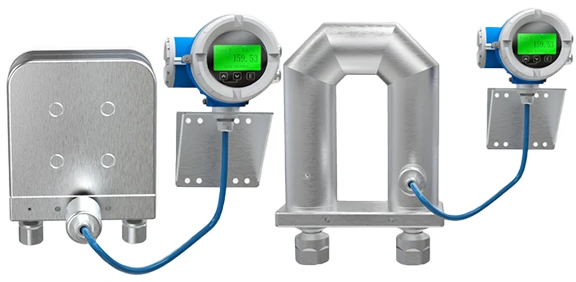
Liquid ammonia at +20 °C has a density of about 610 kg/m³ and is under its own vapour pressure, usually 0.8-1.0 MPa. At -33 °C density rises to 680 kg/m³ and pressure falls to atmospheric.
Any drop below equilibrium causes flashing and two-phase flow. The meter goes where pressure is guaranteed above saturation, and the line is not narrowed upstream.
Ammonia is toxic and explosive. Ex protection, tightness and no air in the line are required: wet ammonia with oxygen attacks copper and some alloys.
| Point | Flow, kg/h | DN | Execution |
|---|---|---|---|
| Refrigeration plant | 500-10,000 | DN15-DN40 | T |
| Truck loading | 10,000-30,000 | DN40-DN50 | T |
| Reactor dosing | 50-1,000 | DN04-DN15 | T |
| Below -40 °C | 500-5,000 | DN15-DN40 | L or D |
Dry ammonia usually allows 316L. If moisture or impurities are possible, material is selected from the corrosion table: 904L, duplex, Hastelloy, titanium and tantalum are available.
Below -40 °C, cryogenic execution L is required: -196 to +150 °C, pressure up to 4 MPa, U or Δ tubes, DN08-DN80. For lower temperatures execution D with remote electronics is used.
Pressure and temperature sensors are sometimes enough to monitor a compressor. Coriolis is used where refrigerant mass, ammonia dosing or loading is measured.
Yes, standard T works from -50 °C. Lower temperatures need L or D.
Yes, ammonia is explosive. ME100 and ME200 are available in Ex versions; group IIC covers group IIA.
Yes, but gas accuracy is lower, ±0.5-1.0%. Liquid phase is the usual task.
316L for dry ammonia. Wet ammonia requires selection by concentration and temperature.
Tell us flow, pressure, temperature and DN. We will reply with a configuration and lead time.
Open configurator Request a quoteWe will contact you shortly.
To attach a completed questionnaire, please email it to mass-expert@ame-info.ru.

