Argon is inert, so the task is phase and pressure rather than chemistry: gas in shielding applications and liquid argon at -186 °C are different executions.
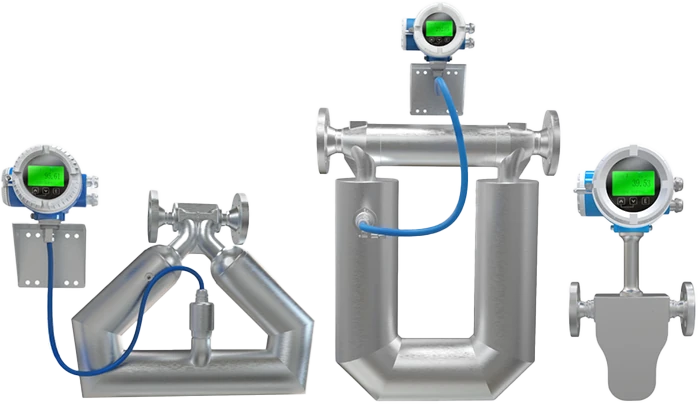
Gaseous argon density is 1.78 kg/m³ at standard conditions; it is heavier than air. Liquid argon boils at -186 °C.
In shielding applications flow stability matters, not chemical resistance. In cryogenic lines phase and back pressure matter.
On evaporation the flow becomes two-phase. The sensor is installed upstream of release points.
| Point | Flow, kg/h | DN | Execution |
|---|---|---|---|
| Shielding gas | 500-10,000 | DN15-DN50 | T |
| Liquid argon | 100-10,000 | DN15-DN50 | L |
| Dosing | 50-1,000 | DN04-DN15 | T |
| Cryogenic refuelling | 500-5,000 | DN15-DN40 | L |
Liquid argon requires L: -196 to +150 °C, up to 4 MPa, U or Δ tubes, DN08-DN80. For gaseous argon T is sufficient.
For shielding gas without mass accounting a rotameter with flow switch is enough. Coriolis is used for mass and cryogenic tasks.
Yes, in execution L down to -196 °C.
±0.5-1.0% depending on size.
It must not reach the sensor. A separator and back pressure are required.
Argon is not flammable; Ex depends on nearby media.
Tell us flow, pressure, temperature and DN. We will reply with a configuration and lead time.
Open configurator Request a quoteWe will contact you shortly.
To attach a completed questionnaire, please email it to mass-expert@ame-info.ru.

