Helium is almost weightless: gas density is 0.16 kg/m³, liquid about 125 kg/m³. Low density means small mass flows, while pressure and tightness requirements are high.
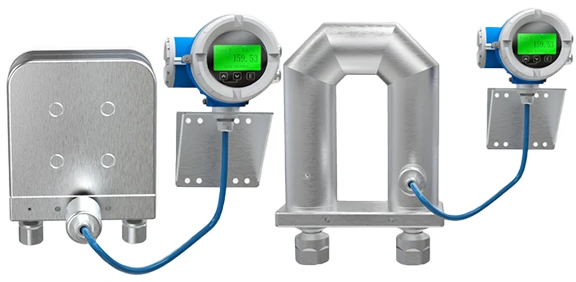
Gas density is 0.16 kg/m³, so mass flow is small even at large volumes. Small DN are used, otherwise the working point falls to the bottom of the range.
Helium is mobile and passes through leaks that hold other gases. Joints and seals require tighter tightness.
Liquid helium boils at -269 °C, below standard executions. Liquid helium needs a separate cryogenic discussion, not a standard L.
| Point | Flow, kg/h | DN | Execution |
|---|---|---|---|
| Gas lines | 5-3,000 | DN02-DN25 | K |
| High pressure | 5-1,000 | DN02-DN15 | PK |
| Supply to customer | 100-3,000 | DN08-DN25 | K |
| Cryogenic lines | 50-1,000 | DN08-DN25 | L |
K-type handles up to 90 MPa, PK up to 96 MPa. The wide U profile gives sensitivity at low flows, which matters for helium.
For large volumes of gaseous helium at low pressure a volumetric method with conversion may be simpler. Coriolis is used for mass and low flows.
Start with DN02-DN15: low density means small mass flows.
-269 °C is below standard executions. A separate calculation is required; L goes to -196 °C.
K up to 90 MPa, PK up to 96 MPa.
Helium passes through leaks that hold other gases.
Tell us flow, pressure, temperature and DN. We will reply with a configuration and lead time.
Open configurator Request a quoteWe will contact you shortly.
To attach a completed questionnaire, please email it to mass-expert@ame-info.ru.

