Glycols absorb water: concentration, density and freeze point change together. A mass meter sees flow and density, so concentration control does not need a separate density meter.
MEG density is about 1110 kg/m³, DEG about 1120 kg/m³ at 20 °C. Water absorbed during gas dehydration lowers density and changes the freeze point.
Density and temperature can be used to monitor concentration if the solution is two-component. If the glycol contains salts or solids, density alone is not enough.
Glycol viscosity is higher than water and rises when cooled. This affects pressure drop and diameter selection.
| Point | Flow, kg/h | DN | Execution |
|---|---|---|---|
| Lean MEG supply | 100-5,000 | DN08-DN25 | T |
| Rich glycol | 100-5,000 | DN08-DN25 | T |
| Antifreeze dosing | 50-1,000 | DN04-DN15 | T |
| Loading | 5,000-20,000 | DN40-DN50 | T |
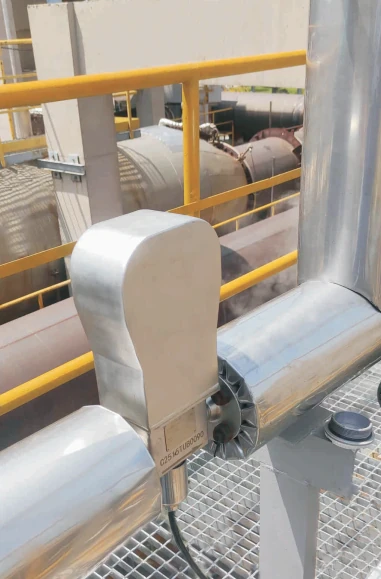
The meter measures mass, density and temperature at the same time. On a dehydration unit this gives glycol flow and an indication of how saturated it is, without a separate density meter.
An exact concentration needs calibration for the specific solution and temperature. For a process trend and early warning, density in line is enough.
If only antifreeze flow at stable composition is needed, a volumetric meter may do. Coriolis is used where mass and concentration control matter.
By density and temperature if the solution is two-component. With salts and solids, calibration is required.
About 16 mPa·s at 20 °C; DEG is higher. It rises in cold weather, so diameter is chosen with margin.
It depends on climate and concentration. Outdoor lines usually need heating in winter.
316L suits clean glycols. With inhibitors and impurities material is agreed separately.
Tell us flow, pressure, temperature and DN. We will reply with a configuration and lead time.
Open configurator Request a quoteWe will contact you shortly.
To attach a completed questionnaire, please email it to mass-expert@ame-info.ru.

