Oil is viscous, non-conductive and contains additives. A mass meter measures mass and density, and a straight-tube sensor has no dead pockets.
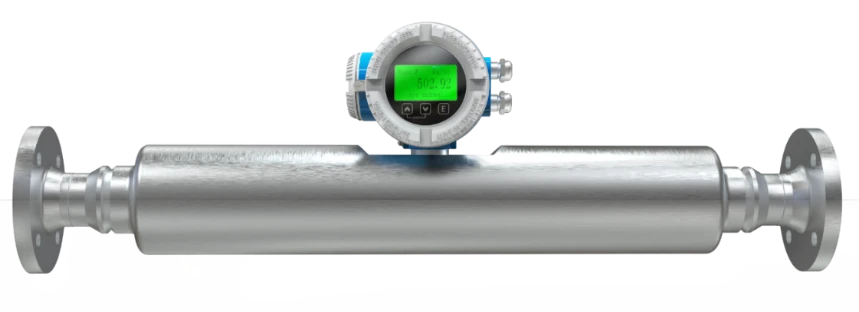
Industrial oil density is 850-900 kg/m³, viscosity from 20 to 100 mPa·s and higher. On cooling viscosity rises and pressure drop increases.
Oil does not conduct, so a magnetic meter is not suitable. Volumetric metering needs density and temperature.
Additives and oxidation products may settle. A straight-tube sensor is easier to flush and has no pockets.
| Point | Flow, kg/h | DN | Execution |
|---|---|---|---|
| Can filling | 1,000-10,000 | DN25-DN40 | T |
| Additive dosing | 50-1,000 | DN04-DN15 | T |
| Line supply | 500-5,000 | DN15-DN40 | T |
| Depot metering | 5,000-20,000 | DN40-DN50 | T |
In oil blending the mass of the component matters, not volume: base oils differ in density. The meter gives mass directly and density for batch control.
For simple circulation without accounting a gear or volumetric meter will do. Coriolis is used for dosing and custody transfer.
Oil does not conduct.
DN25 handles 12,000 kg/h; 5 t/h is 42% of span.
Yes, at small DN from DN04, with mass accuracy.
It affects pressure drop. Diameter is chosen for cold start.
Tell us flow, pressure, temperature and DN. We will reply with a configuration and lead time.
Open configurator Request a quoteWe will contact you shortly.
To attach a completed questionnaire, please email it to mass-expert@ame-info.ru.

