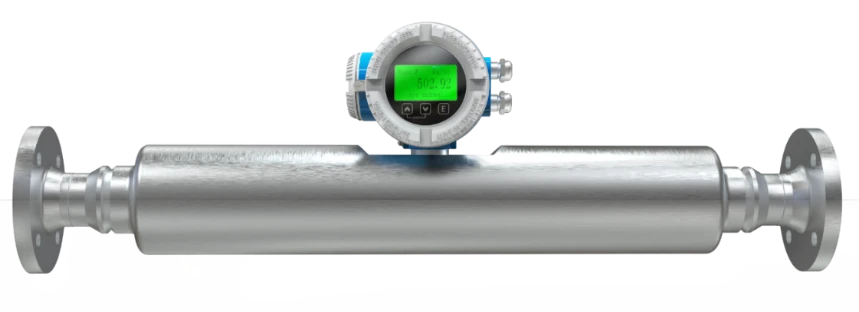
Oil is viscous and non-conductive. A mass meter measures mass and density, and a straight-tube sensor has no pockets and cleans well.
Vegetable oil density is 900-925 kg/m³ at 20 °C, viscosity 50-80 mPa·s and higher. Viscosity falls when heated and rises when cooled; in winter oil may solidify in the line.
Oil does not conduct electricity, so a magnetic meter is not suitable. Volumetric meters work but require density and temperature corrections.
After pressing and refining, oil contains suspended matter and phosphatides. A straight-tube sensor without bends accumulates less deposit and is easier to flush.
| Point | Flow, kg/h | DN | Execution |
|---|---|---|---|
| Truck loading | 10,000-20,000 | DN40-DN50 | T |
| Bottling | 1,000-5,000 | DN25-DN40 | T |
| Additive dosing | 50-1,000 | DN04-DN15 | T |
| Raw material intake | 5,000-20,000 | DN40-DN50 | T |
Oil is sold in tonnes and litres. The meter gives mass directly and density in line, so litre conversion does not depend on the batch certificate.
For food lines Tri-Clamp and design to 3-A requirements are available. It is sanitary design, not a certificate.
If only filling volume matters and density is stable, a volumetric meter can be used. For oil it still needs a density meter and corrections, so Coriolis is often simpler.
Oil does not conduct. A magnetic meter does not work on it.
DN25 handles 12,000 kg/h; 5 t/h is 42% of span, a normal working point.
Yes, T up to +150 °C, straight-tube sensor with Tri-Clamp, CIP/SIP.
It affects pressure drop and velocity. For thick oil the diameter is chosen with margin.
Tell us flow, pressure, temperature and DN. We will reply with a configuration and lead time.
Open configurator Request a quoteWe will contact you shortly.
To attach a completed questionnaire, please email it to mass-expert@ame-info.ru.

