Fuel oil is pumped hot. What matters is velocity in the tube and stable temperature, not only meter accuracy.
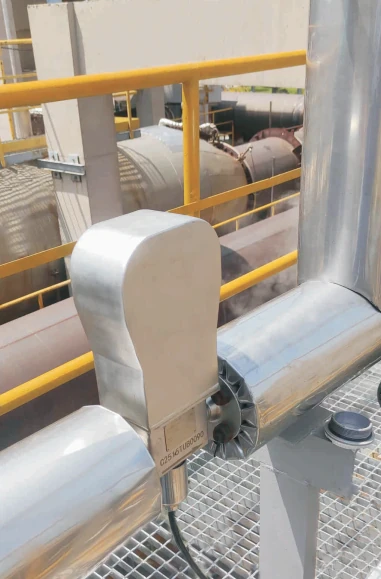
Fuel oil density is 940-1010 kg/m³, viscosity at 50 °C is measured in hundreds of cSt. It is heated to 60-90 °C and the temperature is kept along the whole line, including the meter.
On cold sections and in dead pockets the oil cools and leaves deposits. A straight-tube sensor without bends accumulates less dirt and is easier to flush.
Velocity is kept around 1-3 m/s: too low gives deposits, too high increases pressure drop on a viscous medium.
| Point | Flow, kg/h | DN | Execution |
|---|---|---|---|
| Transfer to boiler house | 10,000-60,000 | DN40-DN80 | T |
| Truck loading | 20,000-60,000 | DN50-DN80 | T |
| Burner dosing | 1,000-5,000 | DN25-DN40 | T |
| CHP metering | 10,000-50,000 | DN40-DN80 | T |
Fuel oil is accounted in tonnes. Coriolis gives mass directly, and density in line shows whether the batch is watered or normal. This is more useful than calculating from a certificate density.
For higher temperatures there is execution G up to +230 °C. Fuel oil usually needs T up to +150 °C; if the line runs hotter, G with remote electronics is required.
If only transfer indication and pump protection are needed, a simpler meter will do. Coriolis is used for custody transfer, density and water content trend.
The straight-tube L is easier to flush than bent tubes. Heating, velocity and scheduled flushing reduce the risk.
Usually 60-90 °C depending on grade. T handles up to +150 °C.
Yes, DN50-DN80. Drain and protection against water hammer on valve closure are required.
Density shows a deviation, but the water percentage is not derived from density alone.
Tell us flow, pressure, temperature and DN. We will reply with a configuration and lead time.
Open configurator Request a quoteWe will contact you shortly.
To attach a completed questionnaire, please email it to mass-expert@ame-info.ru.

