Milk is paid by weight, not by volume: density varies with fat content, temperature and batch. A mass meter measures weight directly, so intake and transfer agree without corrections.
Milk density is 1028-1033 kg/m³ at 20 °C. At 70 °C it drops to about 1010 kg/m³: volumetric flow rises, mass stays the same.
After CIP the line keeps air and foam. An air pocket distorts density, and volume is calculated from density. Volumetric metering at filling drifts before mass does.
Milk conducts electricity, so a magnetic meter works, but it gives volume, not mass, and is sensitive to air and foam. Ultrasonic meters are sensitive to flow profile and viscosity.
| Point | Flow, kg/h | DN | Execution |
|---|---|---|---|
| Intake | 5,000-25,000 | DN40-DN80 | T |
| Pasteurisation | 3,000-12,000 | DN25-DN40 | T |
| Filling | 3,000-10,000 | DN25-DN40 | T |
| Starter, additives | 100-1,000 | DN08-DN15 | T |
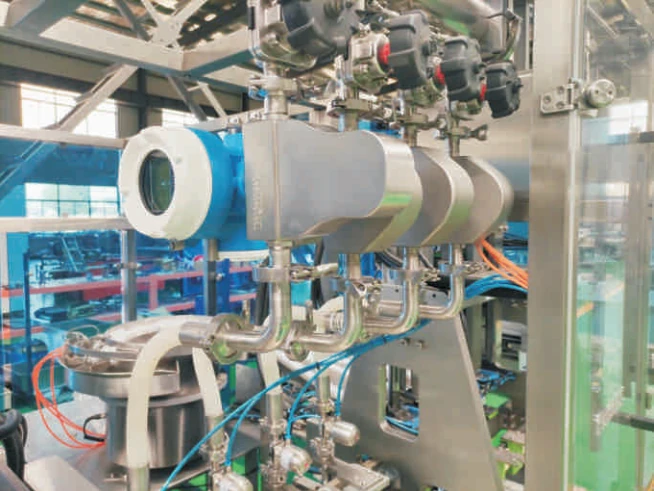
Filling and intake use the straight-tube sensor L: DN08-DN50, Tri-Clamp by default, medium temperature -50 to +150 °C, pressure up to 10 MPa. A straight bore cleans well and holds no residue.
Design to 3-A requirements is available as an option. It is sanitary design, not a 3-A certificate.
If only shipping volume matters and density is stable, a magnetic meter is cheaper. At intake and filling the figure is usually kilograms, so Coriolis remains the default choice.
Density changes with batch and temperature. A litre at intake and a litre at filling can mean different kilograms. Mass does not depend on temperature or fat content.
DN25 handles up to 12,000 kg/h, but 10 t/h is 83% of span, the top edge. The working zone is 60-80%, so DN40 with 27,000 kg/h is calmer.
Release the air, allow a pause, mount the sensor on a rising run. If air is constant, install a gas separator upstream.
Yes, T up to +150 °C, straight-tube L with Tri-Clamp, CIP/SIP. Check cleaning temperature and pressure against the data sheet.
±0.1% of mass for liquids, density ±1 kg/m³. The final uncertainty depends on diameter and working point.
Tell us flow, pressure, temperature and DN. We will reply with a configuration and lead time.
Open configurator Request a quoteWe will contact you shortly.
To attach a completed questionnaire, please email it to mass-expert@ame-info.ru.

