Caustic soda has two problems: it crystallises when cooled and causes stress corrosion cracking. The meter and piping are selected for concentration and temperature.
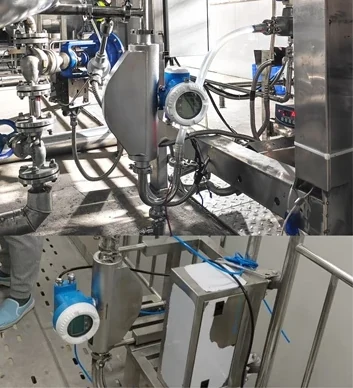
NaOH solution density depends on concentration: 10% is about 1110 kg/m³, 30% about 1330 kg/m³, 50% about 1520 kg/m³ at 20 °C. Density can be used to control concentration when temperature is known.
A 50% solution freezes at about 12 °C, so the line is heated in winter. Crystals clog the sensor and valves, and after dissolving they cause a concentration spike.
Hot concentrated caustic causes stress corrosion cracking. 316L is not suitable everywhere: hot concentrated solutions need a nickel alloy.
| Point | Flow, kg/h | DN | Execution |
|---|---|---|---|
| Reactor dosing | 50-3,000 | DN04-DN25 | T |
| Dilution | 500-10,000 | DN15-DN40 | T |
| Loading | 10,000-30,000 | DN40-DN50 | T |
| Cleaning supply | 500-5,000 | DN15-DN40 | T |
Diluted solutions at moderate temperature usually allow 316L. Hot concentrated solutions need C4 or Hastelloy. The final choice is made against the corrosion table and temperature.
Density in line shows whether the solution is on specification or diluted. An exact percentage needs temperature and calibration, but the trend is visible immediately.
If only cleaning supply volume is needed and concentration is stable, a magnetic meter may do. Coriolis is used for dosing, mass accounting and concentration control.
A 50% solution at 12 °C. Heating and minimum velocity prevent plugs.
316L for diluted solutions and moderate temperatures; C4 or Hastelloy for hot concentrated solutions.
By density and temperature if the solution is two-component. Accuracy depends on calibration.
Caustic itself is not flammable, but if flammable gases or vapours are present nearby, Ex is discussed separately.
Tell us flow, pressure, temperature and DN. We will reply with a configuration and lead time.
Open configurator Request a quoteWe will contact you shortly.
To attach a completed questionnaire, please email it to mass-expert@ame-info.ru.

