Gas condensate is lighter than crude and saturated with dissolved gas. When pressure drops, gas breaks out and the flow becomes two-phase, so back pressure matters more than meter accuracy.
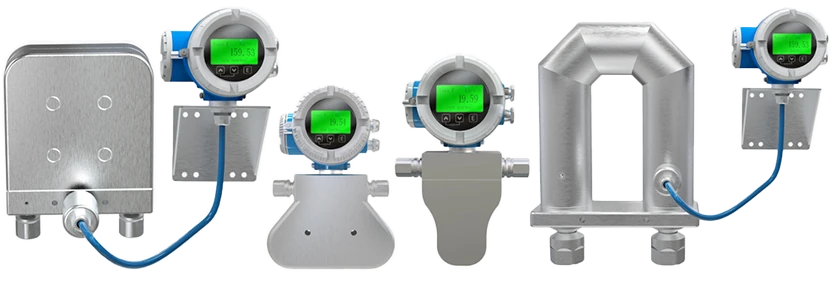
Condensate density is 700-800 kg/m³; it is lighter than crude and carries light fractions. When pressure falls they break out and the flow becomes two-phase.
Free gas distorts tube vibration. The sensor goes where back pressure is maintained, and a separator is used if gas content is unstable.
Gas treatment pressures are high. Execution P covers lines up to 45 MPa; PK up to 96 MPa for special cases.
| Point | Flow, kg/h | DN | Execution |
|---|---|---|---|
| Gas treatment unit | 20,000-100,000 | DN50-DN100 | P |
| Methanol dosing | 50-1,000 | DN04-DN15 | P |
| Condensate metering | 30,000-100,000 | DN50-DN100 | P |
| High-pressure lines | 10,000-50,000 | DN25-DN50 | PK |
The meter gives mass and density of the mixture. For custody transfer this is enough if composition is stable. Component analysis needs a laboratory or analyser.
If only transfer control is needed, a simpler meter will do. For condensate accounting Coriolis is convenient because it needs no density correction.
When pressure drops, gas breaks out and the flow becomes two-phase.
Usually P up to 45 MPa; PK up to 96 MPa for special cases.
No, the meter gives mass and density. Composition is determined separately.
Tube material is selected for hydrogen sulphide content.
Tell us flow, pressure, temperature and DN. We will reply with a configuration and lead time.
Open configurator Request a quoteWe will contact you shortly.
To attach a completed questionnaire, please email it to mass-expert@ame-info.ru.

