Associated gas is unstable: composition, pressure and humidity vary from well to well. A mass meter gives mass, and standard volume is calculated from the entered density.
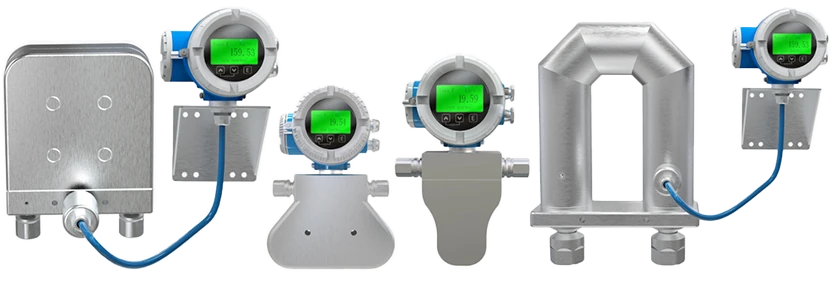
APG density is 0.8-1.2 kg/m³ depending on heavy fractions. Composition changes, so standard density is entered from actual data, not from a reference book.
The gas contains moisture and hydrogen sulphide. Condensate must not reach the sensor, and tube material is selected for H2S.
Field pressure is usually 1-10 MPa. High-pressure lines use P or PK executions.
| Point | Flow, kg/h | DN | Execution |
|---|---|---|---|
| Test unit | 500-20,000 | DN25-DN80 | T |
| Flare gas | 500-10,000 | DN25-DN50 | T |
| Own needs | 1,000-20,000 | DN40-DN80 | T |
| High-pressure lines | 1,000-30,000 | DN25-DN80 | P |
Mass does not depend on composition. Standard volume is calculated from the density entered at setup. If composition changes often, density is updated from laboratory data.
Large flows at low pressure usually use ultrasonic or differential pressure meters. Coriolis wins at small and medium flows.
Yes, but tube and seal materials are selected for hydrogen sulphide.
±0.5-1.0% on gas depending on size.
Not for mass. For standard volume, density at standard conditions is required.
It must not reach the sensor. A separator and heating may be required.
Tell us flow, pressure, temperature and DN. We will reply with a configuration and lead time.
Open configurator Request a quoteWe will contact you shortly.
To attach a completed questionnaire, please email it to mass-expert@ame-info.ru.

