Juice with pulp behaves like a suspension: viscosity varies and solids settle in dead zones. A mass meter measures mass and density, and a straight-tube sensor is easier to clean.
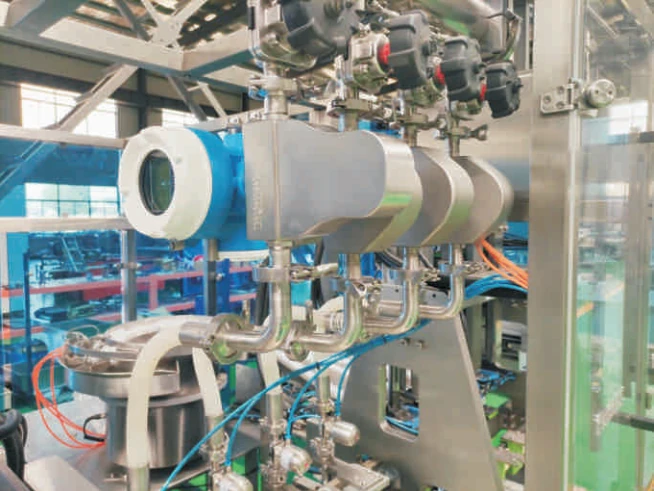
Juice density is 1040-1060 kg/m³; viscosity depends on pulp and temperature. Concentrates are noticeably thicker and need heating.
Pulp settles in pockets and bends. A straight-tube sensor without dead zones reduces contamination risk.
After cleaning the line keeps water. The first litres after CIP have lower density, so the start of filling is controlled by density.
| Point | Flow, kg/h | DN | Execution |
|---|---|---|---|
| Filling | 1,000-10,000 | DN25-DN40 | T |
| Concentrate intake | 500-5,000 | DN15-DN40 | T |
| Blending | 1,000-10,000 | DN25-DN40 | T |
| Cleaning | 1,000-10,000 | DN25-DN40 | T |
Mass does not depend on pulp or temperature. Density in line shows whether concentrate or diluted juice arrives and when product starts after cleaning.
If only filling volume at a stable recipe matters, a volumetric meter can be used. For mass and density control Coriolis is simpler.
Straight-tube L without bends accumulates less and is easier to clean.
DN25 handles 12,000 kg/h; 5 t/h is 42% of span.
Yes, with heating if viscosity is high.
The start of product is controlled by density.
Tell us flow, pressure, temperature and DN. We will reply with a configuration and lead time.
Open configurator Request a quoteWe will contact you shortly.
To attach a completed questionnaire, please email it to mass-expert@ame-info.ru.

