For water Coriolis is often overkill: a magnetic meter is cheaper and accurate by volume. Coriolis is used where mass, density or a compact installation matters.
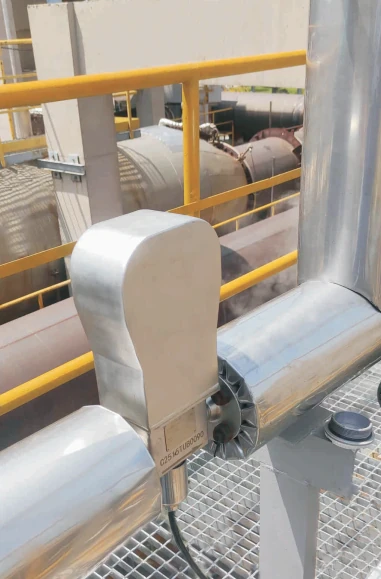
Water conducts, so volume is usually measured by a magnetic meter. Coriolis is needed when mass is counted, density or mineralisation is controlled, or there are no straight runs.
In circulating loops resistance to fouling matters as much as accuracy. A straight-tube sensor is easier to service.
Water density depends on temperature and mineralisation. For process calculations this is sometimes more important than flow.
| Point | Flow, kg/h | DN | Execution |
|---|---|---|---|
| Make-up | 1,000-20,000 | DN25-DN80 | T |
| Circulating loop | 10,000-100,000 | DN50-DN100 | T |
| Reagent dosing | 10-1,000 | DN04-DN15 | T |
| Process line | 1,000-30,000 | DN25-DN80 | T |
If only water volume for balance or make-up is needed, a magnetic meter is cheaper and simpler. Coriolis is justified where mass, density or a compact installation solves the task.
In most water cases. Use it if mass, density or space for straight runs is the issue.
For mass, density, or when there are no straight runs for a magnetic meter.
A magnetic meter if only volume is needed.
By density and temperature if the solution is two-component.
A straight-tube sensor is easier to service.
Tell us flow, pressure, temperature and DN. We will reply with a configuration and lead time.
Open configurator Request a quoteWe will contact you shortly.
To attach a completed questionnaire, please email it to mass-expert@ame-info.ru.

